
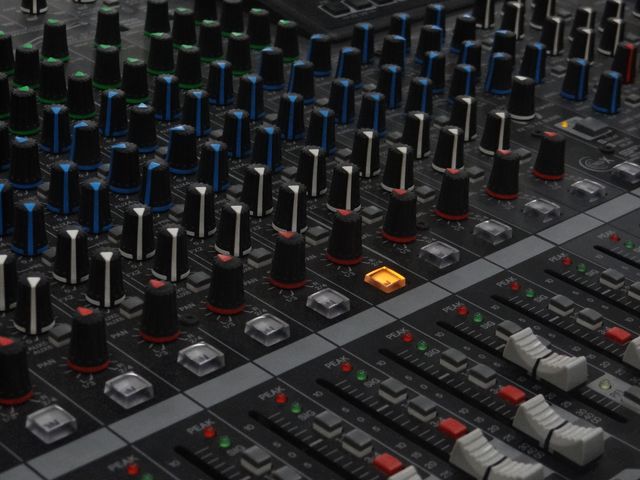
Audio mastering is the final step of music production. It takes a finished stereo mix and prepares it for release by refining the overall tonal balance, controlling dynamics, shaping the stereo image and setting the loudness to the level that streaming platforms target. The result is a track that sounds polished and consistent on every playback system, from phone speakers to a club sound system.
The short version: mixing makes the parts of a song work together, mastering makes the finished song work everywhere.
What mastering actually does
Mastering treats the song as one stereo file rather than as separate instruments. Six things happen at this stage:
Tonal balance. Broad, gentle EQ moves correct a mix that leans too dark, too bright or too heavy in the low end, so the track sits naturally next to commercial releases in the same genre.
Dynamic control. Light compression narrows the gap between the quietest and loudest moments, so a track that felt uneven starts to feel steady and confident.
Loudness. The track is brought to a specific target measured in LUFS, so it plays back at roughly the same perceived volume as everything else in a playlist.
True peak limiting. A limiter catches the peaks that would otherwise distort once a platform converts the file into a compressed format such as AAC or Ogg Vorbis.
Stereo image. Width can be opened up for space or tightened for focus, while the low end normally stays centred so that the track still holds together on mono systems.
Format preparation. The finished file is exported at the right bit depth and sample rate for its destination, whether that is streaming, download or a physical release.
Mastering vs mixing
These two stages get confused constantly, but they work on completely different material.
| Mixing | Mastering | |
|---|---|---|
| Works on | Individual tracks (vocals, drums, bass, synths) | One finished stereo file |
| Goal | Balance the elements inside the song | Make the finished song translate everywhere |
| Typical tools | Volume, panning, EQ and effects per track | Broad EQ, gentle compression, limiting, stereo shaping |
| Changes possible | Anything, since an instrument can be raised or removed | Only the overall sound, since no single element can be isolated |
| Comes | First | Last, right before release |
The practical consequence is that mastering cannot undo mixing decisions. If the vocal is buried or the bass is overpowering, that has to be fixed in the mix. Mastering polishes what it is given.
Why mastering matters more since streaming
Every major streaming service uses loudness normalization. The platform measures how loud a track is, then turns it down if it exceeds the target. This changed the rules completely. Mastering a track louder than the target gains nothing, because the platform simply reduces the volume again, and the track loses punch and dynamics.
These are the current targets:
| Destination | Loudness target | True peak |
|---|---|---|
| Spotify | −14 LUFS | −1 dBTP |
| Apple Music | −16 LUFS | −1 dBTP |
| SoundCloud | −14 LUFS | −1 dBTP |
| YouTube | −14 LUFS | −1 dBTP |
| Bandcamp | −10 LUFS | −1 dBTP |
| Club | −8 LUFS | −0.8 dBTP |
Bandcamp, direct downloads and club playback apply no normalization at all, which is why those targets are louder. Nothing turns the track down afterwards, and music made for the dancefloor is played on professional sound systems. Neither publishes a loudness target, so those two figures reflect common practice rather than a platform specification. That is also why the destination matters before mastering starts rather than afterwards.
How to get your music mastered
There are three realistic routes, and the right one depends on the release rather than on principle:
A mastering engineer. A human listens on treated monitors and makes judgment calls specific to the genre. Rates vary widely, but entry-level engineers commonly charge somewhere around 20 to 50 dollars per track, established independents rather more, and boutique studios several times that. Turnaround is usually a few days. This is the right choice for a release that carries real weight, an album that needs to sound cohesive, or a project heading to vinyl.
Automated online mastering. Software analyzes the mix and applies EQ, compression and limiting against a target. It costs a fraction of the price, delivers in seconds and has become good enough that many independent releases now use it. It cannot make artistic decisions, but on a clean mix it produces a genuinely release-ready result.
Mastering it yourself. This is entirely possible with the right tools and honest ears, but the learning curve is real, and the hardest part is not the processing. It is judging your own track objectively after hearing it two hundred times.
Audiomastering.io covers the second route. It runs entirely in the browser, sets the loudness automatically for the destination you choose, and lets you compare the master against your original mix before exporting. Nothing is uploaded to a server and no account is required.
How to prepare your mix for mastering
Whichever route you take, the result depends on what arrives at the mastering stage. Four rules cover most of it:
- Export a 24-bit WAV or AIFF at the sample rate of your project. Avoid mastering from an MP3 if you can, since the file has already lost information.
- Leave 3 to 6 dB of headroom. The mix should peak around −6 to −3 dB, not at 0. Headroom is the room that mastering needs to work in.
- Take the limiter off your master bus. Any loudness maximizer on the mix does that work badly and in the wrong order.
- Fix the mix first. If something feels wrong, go back to mixing. Mastering makes a good mix better, but it does not repair a bad one.
Can you master your own music?
Yes, and plenty of independent artists do. The two genuine obstacles are monitoring and objectivity. Most home setups colour the sound in ways that are hard to hear, and after a long session with the same track the ear stops noticing problems. Both can be worked around by referencing commercial tracks in the same genre, checking the master on several systems including phone speakers and a car, and taking breaks long enough to hear it fresh.
Automated tools help most with the third obstacle, which is technical accuracy. Loudness targets, true peak ceilings and tonal balance are measurable, so software handles them reliably. The artistic call about how a track should feel stays with you.
Frequently asked questions
Audio mastering is the final polish applied to a finished song before release. It balances the overall tone, controls dynamics, sets the loudness for streaming platforms and makes sure the track sounds consistent on every device.
Mixing balances the individual elements inside a song, such as vocals, drums and bass, using separate tracks. Mastering works on the finished stereo file as a whole and prepares it for release. Mixing comes first, mastering comes last.
Loudness is one part of mastering, but it is not the point of it. Since streaming platforms normalize loudness, a master that is simply louder gets turned back down at playback. Balance, clarity and punch matter far more than raw volume.
No. Mastering can correct broad tonal issues, but it cannot separate the elements of a finished stereo file. A buried vocal or an overpowering bass has to be fixed in the mix.
An engineer usually delivers within a few days, depending on revisions. Automated online mastering takes seconds, which makes it practical to master a track several times while still working on the mix.
It depends on the destination. Spotify, YouTube and SoundCloud normalize to −14 LUFS, and Apple Music to −16 LUFS. Bandcamp, direct downloads and club playback use no normalization at all, so those masters are made louder.
Not necessarily, but a mastered demo is easier to judge. It sits at the same loudness as the commercial tracks it will be compared against, which makes the comparison fair rather than flattering the other track by default.
Getting started
Mastering is often treated as something mysterious, and part of that is fair. The judgment behind a great master takes years. The technical foundation underneath it, though, is measurable and well defined: correct loudness for the destination, a true peak ceiling that survives compression, a tonal balance that holds up next to commercial releases, and a stereo image that translates to mono.
That foundation is exactly what a good automated master delivers, and it takes seconds rather than days.